

A Regency Giltwood Convex Mirror
A giltwood four light convex mirror.
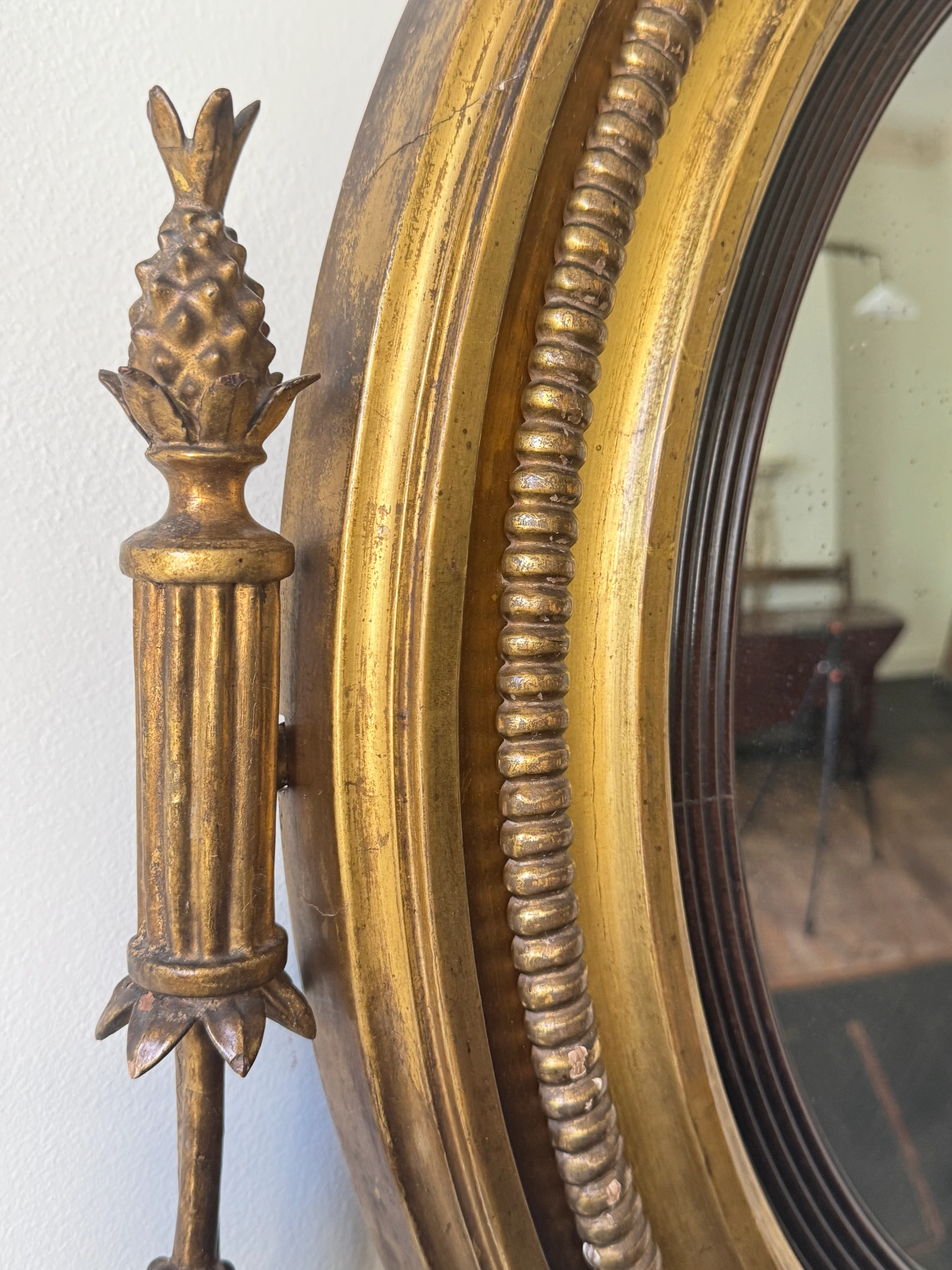
The original convex mercury glass plate set in a reeded ebonised slip surrounded by a gadroon moulded giltwood frame, scrolled foliate branches with brass candle sconces.
Unadorned, chic with good scale, mellow, soft gilt surface, highly original.
Circa 1805-1810.
Height 25.75in (65.5cm).
Width 42in (107cm).
Depth 10in (25.5cm).
Comparable mirrors were produced by Thomas Fentham (1774-1825) 136 The Strand, London and Dublin carver and gilder Richard Jackson (1786-1827), in his "looking glass warehouse" at 5 Essex street.
These "golden sphere mirrored sconces" were popularised in the early 19th century by Thomas Sheratons "Cabinet Dictionary" of 1803 and George Smiths "Collection of designs for household furniture and interior decoration" of 1808.
The initial design of these popular mirrors was influenced by Roman acanthus wreaths with palm flowered brackets and alter finial embellishments, the later dolphin scale frames recall venus's triumph, while the sphere guarding eagles often seen symbolise the sky God Jupiter..
Product Information
Product Information
Shipping & Returns
Shipping & Returns
Description
A giltwood four light convex mirror.
The original convex mercury glass plate set in a reeded ebonised slip surrounded by a gadroon moulded giltwood frame, scrolled foliate branches with brass candle sconces.
Unadorned, chic with good scale, mellow, soft gilt surface, highly original.
Circa 1805-1810.
Height 25.75in (65.5cm).
Width 42in (107cm).
Depth 10in (25.5cm).
Comparable mirrors were produced by Thomas Fentham (1774-1825) 136 The Strand, London and Dublin carver and gilder Richard Jackson (1786-1827), in his "looking glass warehouse" at 5 Essex street.
These "golden sphere mirrored sconces" were popularised in the early 19th century by Thomas Sheratons "Cabinet Dictionary" of 1803 and George Smiths "Collection of designs for household furniture and interior decoration" of 1808.
The initial design of these popular mirrors was influenced by Roman acanthus wreaths with palm flowered brackets and alter finial embellishments, the later dolphin scale frames recall venus's triumph, while the sphere guarding eagles often seen symbolise the sky God Jupiter..